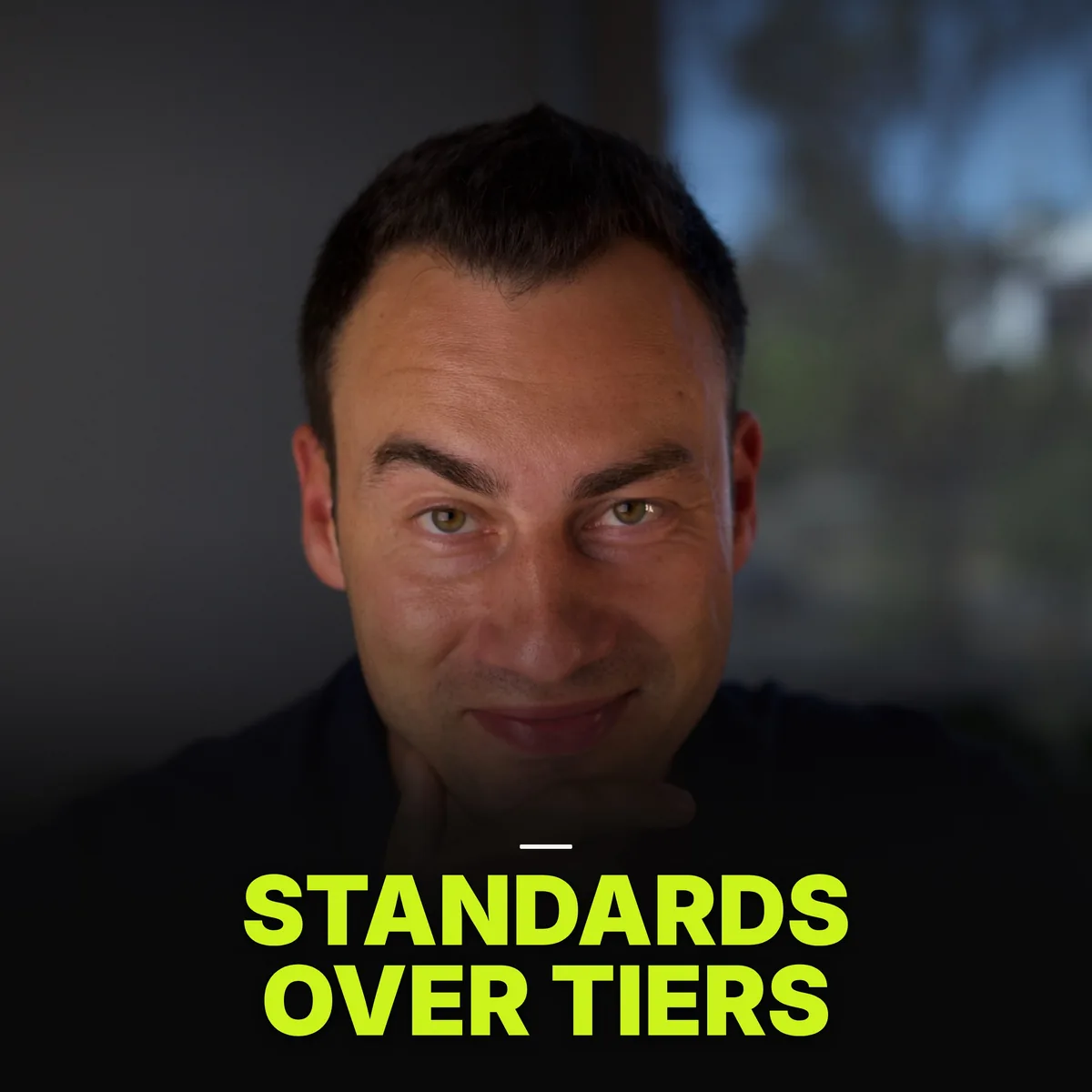
Why This Healthcare MSP Moved Every Client to One Security Standard
with Stuart Millington
Stuart Millington runs Bluebird IT, a healthcare-focused managed service provider (MSP) in Mandurah, Western Australia. Bluebird started with three pricing tiers, went down to two, and ended with one set of security standards that every client follows. When he told clients "this is our price, this is what it is," the ones who came back to him simply said: okay, I understand.
About 85% of his clients are in healthcare, and the person Bluebird works with day to day is the practice manager, who takes pressure from doctors, owners, receptionists and patients. Stuart explains how his team takes vendor problems off their plate, how a traineeship in Broken Hill led to an MSP of his own, and the accountability group where things took off. He also shares why clients now tell him they found Bluebird on ChatGPT and Claude, and why his long-term goal is a business one of his children can take over.
What we cover
- Moving from three pricing tiers to one security standard every client follows
- When healthcare became the rule, and the finance, recruitment and arborist clients who stayed
- Why the practice manager is the linchpin, and dealing with their software vendors for them
- From a one-year traineeship in Broken Hill to an MSP of his own
- Referrals, local networking, and clients who found Bluebird IT on ChatGPT and Claude
- Australia's Privacy Act, keeping data in the country, and DefensX for controlling artificial intelligence (AI) access
- Monthly reports as proof for Royal Australian College of General Practitioners (RACGP) audits
- A long-term goal of handing the business to one of his children
Chapters
- 00:00From three pricing tiers to one standard
- 00:32Meet Stuart Millington
- 00:54When healthcare became the rule
- 01:24About 85% of clients in healthcare
- 02:46Guiding other prospects to trusted peers
- 03:37From general practices to wider medical
- 04:15A general stack serving healthcare
- 04:57Making the practice manager's life easier
- 05:36Turning automation into recurring revenue
- 06:30Why the practice manager is the linchpin
- 07:16From Broken Hill to a first tech job
- 08:30Moving to Perth and finding a mentor
- 09:41Why he started his own business
- 10:18Peel Chamber, Tech Tribe and a peer group
- 11:21From home office to a shared workspace
- 11:58Sharing an office with a client
- 13:00Pushing through the hardest early years
- 15:46Referrals, and clients from ChatGPT and Claude
- 16:54Where practice managers spend time online
- 17:25Why he'd rather help than sell
- 18:37The stack: HaloPSA, NinjaOne, Huntress, Hudu
- 19:43Site photos for clients 20 hours apart
- 20:10Privacy Act and keeping data in Australia
- 21:58DefensX for artificial intelligence controls
- 22:24Taming the pull of shiny new tools
- 23:28Newsletters, Best Practice and MedicalDirector
- 24:18Pricing tiers and the security standard
- 24:57Reports that show trust is earned
- 25:45Roll-ups and American buyers in Australia
- 26:30Handing the reins to the next generation
- 27:16Systems built to grow before hiring
- 27:33Lightning round
- 30:28Who survives the next five years
The guest
Transcript
Lightly corrected captions from the published episode. Timestamps match the audio.
Show full transcriptHide transcript
We originally started out as three tiers and found that it then went down to two tiers. You've either got these extra security features or you don't. And it quickly whittled down to you should have these anyway. If you want to be a client of ours then you need to follow what our standards are. And to be fair there was no pushback on it at all. We just said this is our price, this is what it is. And everyone that’s come back gone, Okay, I understand.
Welcome to Play It Smart. Where the smartest founders in managed IT, security and AI show how they actually build. I'm Alexej Pikovsky. My guest is Stuart Millington. He runs a healthcare-focused MSP in Western Australia. No overseas help desk. And his team answers in under five minutes. Stuart, welcome to the show. Thanks. Thanks for having me. Awesome. So I'll start with when did healthcare only stop being a preference and become the rule and what did you turn away to get there?
It probably, it was always a thought for us to always have that one niche. We're going to just focus on medical. But it was really probably the last six months that we really knuckled down on saying, no, this is where we want to go. This is the right path for us because this is what we know. Okay. So today, how many clients are actually healthcare versus non-healthcare in terms of percentage? Percentage-wise, I would say there's about 85 % that is healthcare.
And the remaining is a mix of, we've got finance, recruitment companies, arborists. So kind of companies that we picked up along the way because that followed our morals and ethics. Right. And I guess like, why did it take you so long to niche down then, right? Like if you have 85 % today, it means probably a year ago you had maybe like 70%, right? Why did you not niche down earlier? No, we always had that focus of like our website had always been medical.
Everything we would advertise would show as medical. But part of our Peel Chamber that we're in, part of our working with in a co-working place, it was picking the clients up from that where they're like, oh, you do IT, can you help me? And that's where we've gone, oh, yeah, we can help with that. So that's how that came about for those people that weren't part of the medical industry. Okay, okay. But now, are you going to say no to them or are you still going to take them on? It's just you're more aggressive on the niching.
We tend to guide people to other IT companies when it comes to that side of it. I'm a big believer in supporting other IT companies. It's part of how I've been able to get to where I am is from the help of other IT companies as well. It's something that I want to be able to share that with. So yes, while we would only take on clients that were the same as us from a moral and ethical point of view, it's only been recently that we're saying, no, you're not medical. Therefore, we suggest these people, because we know this company is a good company to work with.
Makes sense. And then within medical and healthcare, I know in the US sometimes they even focus on like, dentists only or home care providers only. Have you thought of niching down even more? That's kind of where we started. We were focused only on general practices to begin with and aged care facilities. And then it kind of went to, yes, we're doing that, but we're finding a lot of the other medical industry is sharing the same products or having the same kind of issues. So we kind of expanded to include those as well.
And you mentioned there that the industry shares a lot of other products, right? So like in your product stack or tech stack, you're offering out to your clients, how much of that, again, maybe percentage of it again, is really industry specific versus the SOC or whatever our PSA or RMM, right? Like how many of the tools are actually healthcare specific? There's actually none that are specific to healthcare. It is all, I mean, the software that they use, we support, but it's their practice management software that is done with another provider.
So we try and be the middle point so that, take practice managers, for example, they're the ones that have, they cop it from the doctors, they cop it from the owners, they cop it from the receptionists, and then they cop it from the clients or the patients. And our focus is to make their life easier because we know they're the ones that get it the worst. So if their product goes down, we will handle that, we will talk to their vendor and we will do everything on their behalf so that's one less problem they have to worry about. So that's where we kind of gel in or fit into that whole equation. Okay, fair enough, fair enough. So on the kind of like record of, yeah, the record software, what about developing more and more automated workflows and some AI, given that you have so many similar clients, have you considered that?
Absolutely. And it's actually part of the accountability group, I mean, is one of our, we catch up every quarter and one of our rocks for this quarter is making sure that we do a workflow or automation of some type for our clients and build one so that we can make it something that we can charge as a monthly recurring revenue. That's probably the next tricky part is trying to, yes, we can build something, but how do you actually generate it so that you constantly receive an income from it in some way or another? Yeah, yeah, fair enough.
And then in terms of who is your counterpart in healthcare? Is it the medical director or is it CEO? How is it usually structured? A lot of structure goes straight through to the practice manager. So they're the linchpin to everything really. A lot of the owners of the business are usually a doctor and they just want to be able to serve their patients, see their patients, make their life as easy as possible. So for us, that's where we deal with the practice manager and the practice manager has either authority or needs to go back to the doctors for approval and so forth.
Got it, got it. All right, cool. All right, now let's go back to all the way to the beginning, the origin story. So yeah, how did you start this business? State of the business or my career, which one do you want to go with first? Well, I guess let's do your career first and then move on to how did you actually start the business then? So I finished high school in Broken Hill in New South Wales, which for anyone not in Australia or even in Australia, Broken Hill is where BHP is from. So the largest metal company in the world, old mining company.
And there's nothing around Broken Hill. You're either in mining or you're not. And I finished high school and I wasn't too sure what I was going to do with my life and Dad said, why don't you go to TAFE and do some stuff with computers. You like computers. And I thought, well, all right, until I grow up and figure out what I want, I'll go work with computers. And then I got a traineeship with the Department of Education over there.
That was a one year traineeship. And I really enjoyed it. Found that, yes, this is what I'm good at. I'm enjoying it. And then got a job with another company local. I didn't feel like there was anywhere for me to grow. So I went on a holiday with my partner at the time and we came over to Perth for one week. And that was all it took. I was like, yep, I'm moving to Perth. And two weeks later, we had everything packed up, ready to go and across we came.
From there, I got a job fixing ATMs and sort of went, well, this is a job, but it's not a career. And found that for me, fixing computers is what I wanted to do. And got a job with a company that is, well, at the time wasn't an MSP, I guess, because they weren't a thing, but evolved into an MSP. And for me, the person that was my boss is probably one of the biggest role models I've got in the IT industry. He helped me with everything. He was super patient, always there and always willing to show me things. And I just really felt I grew from that.
I moved south of Perth, where I live now, in Mandurah, which is about an hour south of Perth. Worked for another company there for a couple of years and my wife was pregnant at the time. Well, we just had our fourth child at the time. And I came in one day completely, I guess, beaten down. I just felt like we weren't offering the services that we should be offering, the support. And I said, that's it. I've had enough.
We're going to start my own business and we're going to figure it out. And we had no idea. So the first thing my partner did at the time, she just Googled how to start a business. And that's pretty much how we started. We joined up with the local Peel Chamber and then jumped on to Tech Tribe within probably the first two months. And got so much wealth of knowledge from that. And then after that, we joined an accountability group as part of Tech Tribe. And that's where things just took off for me. Everything.
There's five of us, six of us across the country, all in different states. And everyone is there to help each other. You know, we've got businesses that are making millions of dollars a year to businesses that are making under 500 ,000 a year. And everyone's there with the same, I'm here to help, I'm here to grow and what have you come across? And that, for me, changed a lot of things and was able for us to grow quite significantly because of it.
So yeah, that's pretty much the story of where we got to. We were working out of our own home at the time and then moved into a shared working location. And from there, that's where we had this networking group of other businesses in the same boat as us. I'm just starting out or I've only got two or three people, you know, I've got these problems. Have you come across this? And yeah, we're an IT company, but we had lawyers and financial advisors, travel health, travel care, having the same problems as us. I'm like, oh, this is not specific to me and I've got somewhere to talk to.
And then one of who I class a very close friend now had her business and she said, oh, I'm moving out of this building because we're growing too big, do you want to move out? And I'm like, oh, I really don't, I really like the networking here. And then she basically, she convinced me to move out. I'll put it nicely, she convinced me nicely to move out and move in with them. And so we've got an NDIS organisation who we support in the same building as us. And it's been probably the best two years of our careers because we've been able to bounce stuff off each other. She has a desk right next to me where she goes through her problems and, you know, I've had this kind of problem before and vice versa. And it's just been phenomenal to be able to have that feeling that you're not alone in a business. And it doesn't matter what type of industry it is, people still have those same kind of problems, which is excellent.
Yeah, absolutely, absolutely. And yeah, I'm a big fan of peer groups and masterminds for sure. Tell us a bit more about the challenges maybe along the way, right? As you were launching the business and also, you know, maybe before you moved to the co-working space, yeah. Yeah, so when, before we started the business, I made it very clear to my previous boss that I'm going to start my own IT company. And he was not happy about it, but he was okay.
So then I didn't say anything to anybody. I just said, I'm finishing up in this company. I'm leaving. And then he started noticing clients were leaving as well. They weren't coming to me. They were just leaving in general. And he got very upset and tried to sue me for it. So from pretty much day one, I've had someone try and sue me for starting my own business. So we're able to get through that hurdle. Financially, yes, it took a hit for us, but we're able to at least learn from it and go, we know we haven't done anything wrong. We've done everything right.
And we're finding ourselves surrounded by the right people now. So yeah, that was probably the first year and a half going through that. And then by the time we got through that, my partner and I decided to go separate ways. So we then basically went from that to a divorce and dealing with a business that's growing to having a divorce and then having staff to hire as well. So I hired Evan and another person at the time.
And I've still got Evan who is an amazing worker. I'm hoping he stays with us forever. He's really good staff. All my staff are. I have no complaints. And going through that and having the divorce, it was a case of, I know I probably handled how to handle the divorce and wrong because I just focused on work and I just went, this is what I'm doing now and I'm just focused on that. For the business, it was great because we grew from that. But from a personal mental health thing, probably not the best idea. But yeah, pushed through it and three and a half years later on the other side of the divorce and yeah, business is going really well.
And your partner, she was also involved in the business initially. She's still involved in the business? No, not at all. So with the divorce she left. So it was co-owned, 50/50 ownership. And yeah, she decided to go her own way and do her own thing at the time. 100% owned by me now. Okay, fair enough, fair enough, fair enough. Yeah, so not an easy time. Not the easiest route. Growing the business initially, right? But yeah, interesting. And then obviously Mandurah is one of the cities or areas you're getting clients from, right? How does your marketing day-to-day look like? You go a lot to networking and in-person events? Or do you do a lot of marketing like digitally? Or yeah, tell us about your marketing tech. We actually don't do any marketing at all.
A lot of it is referral based. But also, yeah, we're part of, like I said, the Peel Chamber where we get, I wouldn't say referrals, but we get that networking side from that. And that's how we also have been able to pick up clients. But a big thing that we've noticed recently has been our AEO/GEO on our website. We've been having clients reaching out to us from all over the country, all over the state, sorry. And they've just gone, I found you on Claude or I found you on ChatGPT.
And I'm like, excellent, we know that's working now. So we're doing the right thing there. And that's really where we've gone. I've looked into Google Ads. I've looked into Facebook. I've looked into LinkedIn. A lot of people say all your clients are going to be on LinkedIn. 90 % of our general practice managers aren't on LinkedIn. They use Facebook and they use Facebook practice manager groups and things like that. But we've not gone down that route because at this point we're at a size where we're taking on the people that we want.
And we're just growing from that. Have you ever considered giving your niche focus both in the industry and almost like regional? Have you ever considered creating your own WhatsApp group or Facebook group for Medical practitioners in Mandurah? Absolutely. So we've definitely considered it. Tiffany and I have gone through a few different ideas for marketing and what to do in that regard. We just need to find that happy medium when we're not coming across as sleazy, salesman, pushy or anything like that because for me I don't like sales at all.
My philosophy for starting a business was we help the people fix the people. Doctors can't help someone if their software is broken. So if we can fix that then the doctor fixes it. So that fills my bucket. Selling someone a server or hosted services, yes it's needed but it's not my jam. It's not what I enjoy doing. So I feel if I did those groups I'd be worried that that's what comes across as. So I've got to find that happy medium where it's not the case.
And in terms of solving problems, etc. What is your product stack and tech stack? What's your PSA, RMM, SOC, etc. Maybe walk us through that. So we're heavily invested in HaloPSA, Ninja RMM and Huntress is probably our key, three key products. Hudu is probably the fourth which I rely on Hudu, or we all do, like our Bible because we put so much documentation in that. Hudu is like Notion or what's Hudu? Hudu is a documentation system so we have all of our clients in there which will then have their network diagrams their products that they use and then we'll have documentation in how to set up, like our knowledge base basically of how to set up a certain product for a certain client, a certain way and so forth. Okay, how do you spell it? For us, H-U-D-U.
The biggest thing for us is we take photos of sites because we've got clients that are 20 hours apart we need to have photos so that when they call up we can go, oh yeah, it's this one here that you're looking at. Your Meraki device looks like this thing here or your Sophos device or whatever. Having those photos in a central location like that's paramount for us. And how do you deal with this whole HIPAA compliance, probably in Australia there's an equivalent one, right? to HIPAA compliance, is it?
That the system of records the healthcare providers use already covers that and then since you're kind of like sit in between, you'll find as well do you actually have to have some sort of healthcare compliance I don't know, angle like, yeah. Yeah, so for us we've got the Privacy Act in Australia. It's technically the Privacy Act, 1988 that's been updated semi-recently because you would hope so and we're not relying on 1988 information and that is a bit more strict in some regards to HIPAA.
Our data is not technically allowed to be overseas so we need to have the data servers in Australia. We need to make sure that if a server’s replicating to somewhere else it's not replicating to Singapore which is the closest one for us from here. They're replicating between Sydney and Melbourne for example which is a fair distance apart and it's about being proactive in that regard and aware that your PII your personal information is staying locally and not being shared on Claude and people aren't putting in their Medicare details so I can't remember what the American version is the Social Security number putting that information into Claude and just assuming it's okay or ChatGPT.
So it is very, very stringent. So how do you prevent it? Do you have like an AI governance tool or proxy sitting between Claude and... We rely heavily on DefensX as well for that side of it. DefensX has AI built into it as well monitoring so that we can allow AI through or not and that's been a godsend in many regards as well. And in terms of new tools I guess like do you have a habit in reviewing new tools as they come along or what's your approach to that? I'm actually probably shocking for this I see a shiny thing and I have to have it so I need to restrain myself a lot and part of the accountability group is they call you out on your BS and if I see something shiny I'm like I need to have that but why do you need it? And I try and justify it and they're like no that's BS you don't need that I'm like oh alright I know so I am constantly looking at it my staff are great for it as well they're like have you seen this new product?
I'm like oh cool how's it gonna help us? And then I try and put on that same hat as the other tribal group and say how's it gonna help us? What do we have now that won't do that already? And it's about being proactive about it and just saying with the tools we've already got do we need another one? And if we do how's it going to benefit us? So it is a constant thing we read heavily like for us, every day we're getting newsletters from different locations different vendors, different companies that says this is the latest TLDR for example is a great product a great newsletter that we sign up to that we get a lot of information from. We have a lot inside Australia for medical industry in particular that we sign up to and we get that information about AI and their products as well.
The two products that we use in particular Best Practice and Medical Director have AI built into them so that they don't use Copilot or Claude or ChatGPT it's all self-contained which is crucial. And in terms of your pricing strategy you have like one price? Do you have three tiers? How does that work? We originally started out as three tiers and found that it then went down to two tiers you've either got these extra security features or you don't and it quickly whittled down to you should have these anyway if. If you want to be a client of ours then you need to follow what our standards are.
And to be fair there was no pushback on it at all we just said this is our price this is what it is and everyone that’s come back gone, “Okay, I understand.” You get your report at the end of the month for these things if you want them we put it into Halo anyway so that they log into Halo they've got all the reports there we were sending them out every month and it just turned out that people just went we don't even look at these, we don't care we know what you're doing we trust what you're doing.
But for us while it is awesome that they trust us we need to make sure that we're showing that that trust is earned particularly with reporting because part of RACGP is a requirement for them to be certified to have certain requirements put in place and this then shows them when they get audited here's the proof that we're doing the right things so that's why it's super important. And in terms of long term goal in the US obviously there's a lot of MSP rollups happening both PE-backed or AI roll-up-backed. I imagine Australia has a bunch of PEs probably also buying some MSPs what's your plan is your plan to grow the business forever maybe buy other MSPs or grow it sell it and then do something else?
What we're finding in Australia in particular a lot of US companies are coming over and buying them up. But they're buying up MSPs that are probably earning like Evergreen for example I think is $5 million revenue minimum and everything above that for me my goal is not so much about earning so much to be able to sell it I don't want to sell the business anytime soon my long term goal is to be running the business so that one of my children can come in and go I want to do this as well and I can train them and hand them over the reins basically so I think that's where I want to head it. As for growth of how many more staff and so forth.
We've built our systems now where the four of us well three I shouldn't really class myself as IT engineer as much anymore because I do the 5% job and I focus more on building the business. And we've built it so that the foundation is so solid that we don't need any extra staff at the moment for probably another 300 devices at least. So we've got a long way to go before we need to hire anyone else. That's awesome alright so we usually finish off with a lightning round of questions so kind of like a short quick fire with you replying fairly short as well so I guess yeah one tool you couldn't run your MSP without?
Hudu could not run it without Hudu we need those photos we need that documentation. And then most overrated thing in the MSP world right now? AI or the use of the term AI I think is the most overrated thing everything is AI related. Yeah it's crazy how much it is and then you have the next problem of I can't buy hardware because AI have purchased all the RAM and now the price of RAM has gone up and then the price of PCs have gone up and so on so yeah for me it's AI.
And what about the most underrated? I guess um the most underrated from how I feel is the relationship that you build with your clients. Having, building that, like for us being like I said a 20 hour drive between particular clients if you don't have that personal relationship they're out in the middle of nowhere as it is they need they want to be able to talk to someone just have a how's your day how are the kids you know um we get invited to things like other companies 20th birthdays and things like that because we don't see ourselves as a provider of IT solutions we see ourselves as an extension of their family and we want to make sure that the receptionist right through to the CEO gets the same level of appreciation from us because while the CEO is super important in making all these decisions the one at reception still copping hard time and they're not calling us to have a good time because they're having a good time they're calling us because they've got a problem they need a solution to it so we need to make sure they’re heard and felt.
Sorry that wasn't a short answer but it was a really good answer really good answer so uh especially yeah in Australia which is a huge huge huge country right? And as you said 20 hours drive sometimes. Alright what about cloud or on-prem in five years? What do you think, where the industry's going? I... if you had asked me probably 12 months ago I would say um on-prem um because our internet wasn't there but the price of hardware was cheap now that hardware is more expensive and we've got fiber to the premise for most areas and what's not fiber to the premise is fiber to the curb or we've got some Starlink it's probably going to go more towards the cloud I think.
Fair enough and I guess to finish off an MSP that an MSP that survives the next five years will be the one which does what? Works with other MSPs and helps each other grow I think for me um like I said I keep going back to the accountability group. Without that I wouldn't be where I am and I think that's part of why I'm in that Tech Tribe in the um the council as well because I can see the more people help each other the more everyone wins you you give better um advice to an MSP they give better advice to their clients their clients win and then they're going to talk to you um openly as well which just it's a win all round. Amazing. Amazing. But Stuart, this was super interesting and thank you so much. Thank you, I really appreciate it, Alex.
Built something the industry should hear about?
A niche you own. A pricing change that worked. A near-death moment you survived. Just the story of how you actually built it.
Apply to be a guest →